The Female Fatigue Problem Nobody Talks About
(Or: Why Everything You've Been Told About Sleep Was Tested on Someone Else)
There is a 2024 review out of Stanford, Harvard, and the University of Southampton that should have made headlines. It didn't, particularly. It confirmed what many female patients have been saying for years: women are more sensitive to sleep deprivation than men, more likely to be diagnosed with insomnia, and more likely to have poor sleep show up as anxiety and depression rather than sleepiness. Twice as likely on that last one.
The review also confirmed something that gets almost no clinical airtime: sleep quality in women fluctuates across the menstrual cycle. In ways that have real consequences for mood, cognition, and energy. Not theoretical consequences. Measurable ones.
None of this is fringe research. All of it is being largely ignored in how we counsel female patients.
Here's what that actually means in practice.
Your circadian clock is not the same clock.
The average female circadian rhythm runs about six minutes shorter than the male average. Six minutes sounds like nothing. What it means clinically is that your internal cues for sleep and wakefulness tend to run earlier than the standard advice assumes. Your system is naturally inclined toward an earlier schedule.
This matters when you're being told to fight that inclination.
When a sleep protocol pushes you to stay up later to "consolidate" your sleep, or when a handout tells you your early wake times are a problem to fix, that advice was calibrated on research that mostly didn't include you. For women whose natural chronotype runs early, the intervention isn't to push later. It's to stop fighting the clock you actually have.
What actually works with that biology: morning light exposure, which reinforces your natural circadian timing rather than working against it. An earlier wind-down. Tracking your sleep across your cycle, not just logging hours, so you can see what your system is actually doing across different hormonal phases. Many women find their sleep needs shift meaningfully across the month. Adjusting for that is not weakness. It is working with your physiology.
Stacey Sims, an exercise physiologist who has spent her career on exactly this gap, puts it plainly: women are not small men. In sports science this is finally starting to land. In sleep medicine, we're still catching up.
What actually shifts across your cycle.
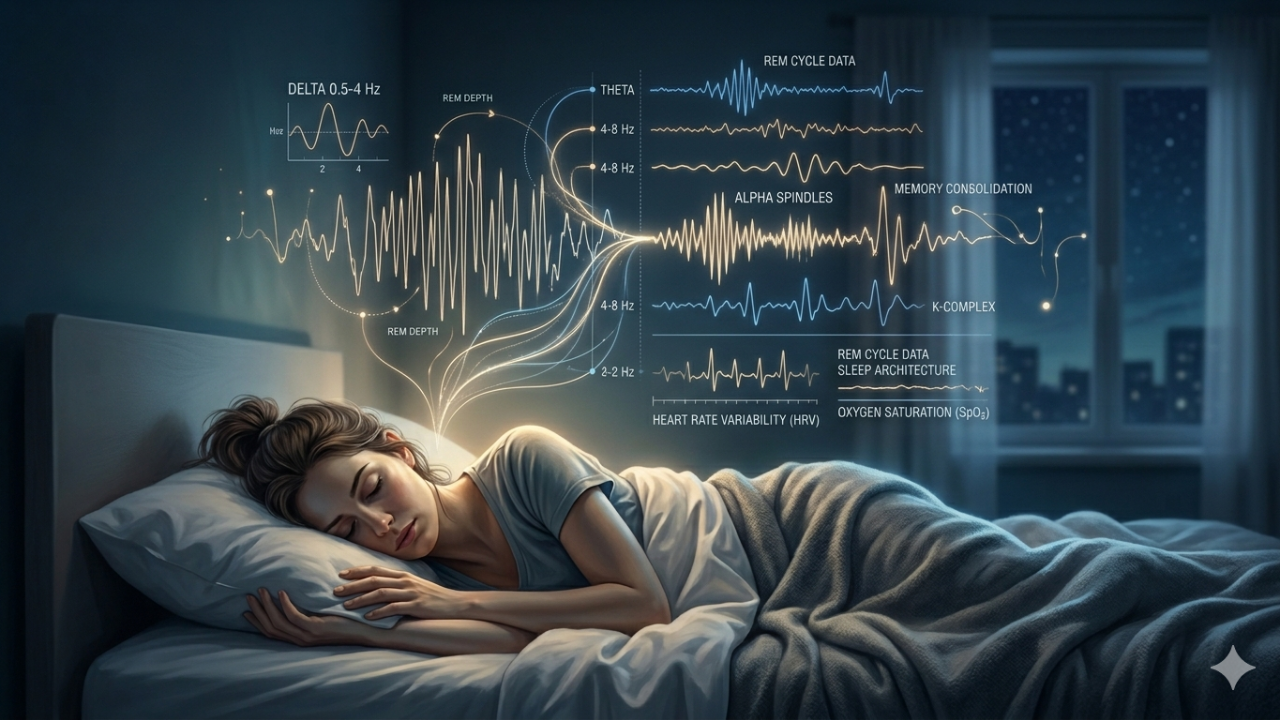
In the follicular phase, estrogen is rising, core body temperature is slightly lower, and sleep architecture tends to be more stable. In the luteal phase, progesterone rises, body temperature rises with it, and REM sleep becomes more fragmented. Many women report waking in the night or feeling unrefreshed despite a full night in bed. This is not anxiety. This is physiology.
For women approaching perimenopause, thermoregulation becomes more volatile. Night sweats are not just uncomfortable. They are a direct disruption to sleep architecture. Your body cannot move properly through sleep stages when it is busy trying to regulate temperature. This deserves a clinical conversation, not another sleep hygiene handout. What that conversation leads to depends entirely on the individual patient. But it should happen.
For women with endometriosis, PCOS, or thyroid disease, add another layer. Pain disrupts sleep. Inflammatory burden disrupts sleep. HPA-axis dysregulation, which shows up across all three conditions, disrupts sleep. (I have endometriosis and Addison's disease. I have personal data on this.)
Why your labs came back normal anyway.
A standard workup covers real ground. A CBC catches anemia. A CMP looks at blood sugar, electrolytes, kidney and liver function. A TSH screens for thyroid dysfunction. That's a reasonable starting point and worth doing.
It still misses things.
Ferritin is the most common miss with the clearest clinical consequence. Low-normal ferritin causes fatigue. It causes restless legs, which fragments sleep. It disrupts dopamine synthesis, which affects mood and motivation. The cutoff for "normal" on most standard lab ranges sits somewhere around 12 to 15. Many women feel significantly better when their ferritin is above 50 or 70. We are not routinely checking for that specifically, and when we do, we are often not interpreting it with that threshold in mind.
This is not a conspiracy. It is what happens when reference ranges get established without sufficient female data and then stay locked in for decades.
The standard workup is a starting point. For fatigued women, it is often not a finish line.
What actually helps.
Not yoga. Not another handout.
Morning light exposure. Tracking sleep quality across your cycle rather than just total hours. Adjusting your schedule when your biology is clearly pulling in a consistent direction rather than fighting it. Cooling your sleep environment, particularly in the luteal phase when body temperature runs higher.
Magnesium glycinate at night has reasonable evidence and a low barrier to try. CoQ10 and NADH if mitochondrial function is part of the picture. Iron repletion and ferritin optimization if your levels are low-normal and your symptoms fit.
And sometimes the most important intervention is a physician who looks at the whole picture at once. Sleep and hormones and inflammation and nutrition and labs interpreted with the right thresholds. Not one referral at a time.
The part I want to say plainly.
If you have been following all the standard advice and still waking up exhausted, you are not failing at sleep. You were given recommendations designed for a different biology, by a system that has been slow to formally acknowledge the difference. That is a research problem. It is not a personal one.
Your fatigue has causes. Some of them are being missed because we weren't asking the right questions. That is what we are trying to fix.
Not sure where your fatigue is coming from? The Fatigue Quiz at thefatigueclinic.org/fatigue-quiz takes about five minutes and covers the categories most often missed.
I'm Dr. Goodwin. Board certified in family medicine. Personally acquainted with estrogen's opinions. Still in it with you.