Ten Years of Meditation (and My Brain Still Won't Shut Up)
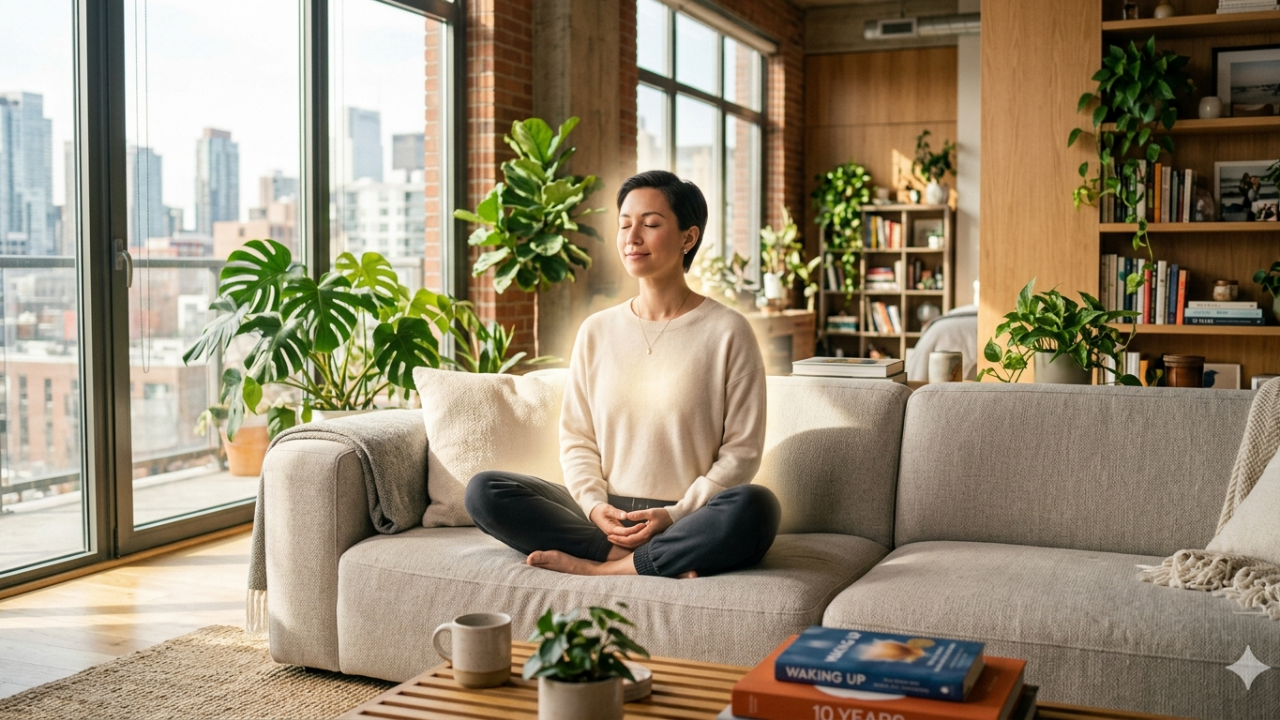
I recommend meditation to people constantly.
Which is slightly ironic, because if you looked inside my head during meditation it would mostly resemble a squirrel convention.
I started meditating in March 2016 because life felt loud and I suspected there had to be some way to calm my brain down that did not involve moving to a cabin in the woods.
Ten years later I’ve logged 1,300+ sessions and spent 239 hours sitting quietly with my own thoughts.
The strange thing is that the biggest benefits of meditation didn’t really happen during meditation.
They showed up in the rest of my life.
Two hundred and thirty-nine hours is a long time to sit quietly with your own brain. Especially when your brain behaves less like a wise monk and more like a caffeinated raccoon.
On paper, this sounds impressive. It suggests I am the kind of person who wakes up at 5am, drinks warm lemon water, and sits cross-legged on a linen cushion while achieving enlightenment before breakfast.
Unfortunately, that is not what happened. My meditation practice has involved significantly less enlightenment and significantly more wondering what I’m going to eat today.
The truth is much messier. I have not meditated every day for ten years. I’ve gone months without doing it at all. Sometimes I drift away from the practice entirely and only come back when life starts to feel loud again.
(It’s actually hilarious to watch the data on meditation apps around the holidays. Every year there’s this giant spike in usage as the entire human population collectively thinks, “Maybe I should sit quietly before I lose my mind.” Every. single. year.)
And yet, even with all that inconsistency, meditation has quietly become one of the most helpful practices in my life.
Honestly, it might be the single most useful habit I’ve ever learned.
I recommend meditation constantly. To friends. To patients. To coworkers who look like they’re about to throw their laptop out a window.
Not because it turns you into a serene monk floating through life glowing with inner peace.
But because it’s one of the few tools I know that reliably makes life feel more manageable, more spacious, and a little less like your brain is driving the car without supervision.
Partly because meditation is not what most people think it is.
First, let's clear something up
A lot of people think meditation means emptying your mind.
If that were the goal, I would have failed permanently on day one.
Meditation is not about turning your brain off. It’s not about becoming emotionless, spiritually superior, or permanently calm. And it definitely does not involve floating three inches above the floor while your problems dissolve. (I wish!)
If anything, meditation mostly proves that your brain is extremely chaotic.
You sit down, close your eyes, and within about forty seconds your brain presents you with:
-
something embarrassing you said in 2009
-
whether you locked the front door
-
the entire plot of a TV show you watched five years ago
-
an email you forgot to send
-
and somehow also pizza
All at once.
This is normal. Deeply annoying, but completely normal. Apparently this is just what brains do when you stop distracting them with snacks and notifications.
My very first meditation attempt
The first time I tried meditation I genuinely thought I was doing it wrong.
The instructions were something like, “Sit comfortably and observe your thoughts.”
Which sounded simple until I sat down and immediately had approximately forty-seven thoughts per second.
Within about three minutes I was mentally planning dinner, remembering something embarrassing I said last week, wondering if enlightened people also think about pizza during meditation, and trying to determine if I was somehow failing at sitting still.
I remember thinking: Am I supposed to stop these thoughts? Organize them? Chase them?
It took me an embarrassingly long time to realize the chaos was the meditation. The goal wasn’t to eliminate the thoughts. The goal was simply to notice them… preferably without following them into a ten-minute fantasy about gardening.
What meditation actually is (at least for me)
Meditation, at least the way I practice it, is really about creating space.
It’s the moment when you notice a thought and realize, “Oh. That’s a thought.” Not a command. Not a prophecy. Just something passing through.
The same thing happens with emotions. Anger shows up. Anxiety shows up. Stress shows up.
Meditation doesn’t make those things disappear. What it does is create a little distance so I don’t automatically grab them and carry them around all day like emotional luggage.
And that small amount of distance turns out to matter more than it sounds.
The mysterious meditation itch
There is also a strange phenomenon that happens the moment you start meditating.
Your body suddenly develops an urgent need to itch every part of your face.
Your nose itches. Your eyebrow itches. The side of your cheek starts itching in a way that feels medically significant.
You sit there wondering if true spiritual discipline means resisting the itch.
It does not.
Scratch the itch. No one is grading you. There is no secret panel of monks keeping score.
The surprisingly practical benefits
Meditation is often presented as something mystical or spiritual.
In reality it’s mostly the practice of noticing that your brain is doing weird stuff and deciding not to panic about it.
In my experience, the benefits are mostly very practical.
Which is why I end up recommending it so often.
If someone tells me their brain feels loud, overwhelmed, reactive, or constantly distracted, meditation is almost always one of the first tools I suggest trying.
Over time it has helped me let go of thoughts I don’t want to keep carrying, stay with the thoughts that actually matter, sleep more easily, and react less quickly when something stressful happens.
None of this happened overnight.
Meditation is not one of those things where you try it for a week and suddenly become a new person who radiates calm energy.
I practiced on and off for about two years before I noticed deeper changes in how I moved through daily life. Even then the shifts were subtle: a little more space in my mind, a little less reactivity, clearer thinking, slightly better sleep.
Small changes. But meaningful ones.
Meditation in a real household
Meditation also looks much less peaceful in a real house than it does in Instagram photos.
I have absolutely been sitting quietly with my eyes closed when my husband walked into the room and started talking to me because, from his perspective, I was simply sitting there doing nothing.
Which is fair.
From the outside, meditation looks exactly like a person who has forgotten what they were doing.
Add dogs barking, doors closing, a vacuum cleaner starting up, and occasionally someone asking where the batteries are and you start to understand that meditation in real life is less like a monastery and more like a slightly chaotic living room.
And that’s actually part of the point. We practice being present in the middle of real life, not in perfect silence.
The weird thing it does to time
One of the strangest effects of meditation is the way it changes how time feels.
Not in a magical way. Meditation does not literally slow time down.
But it does bring attention back to the present moment, and the present moment is the only place life actually happens.
When I'm paying attention, my days stop slipping through my hands quite so fast. When I'm not, entire months seem to disappear.
Meditation doesn't add hours to the day.
It simply helps me inhabit the hours I already have.
Let's Be Honest
Even after ten years, I still drift away from meditation sometimes.
Sometimes for weeks. Sometimes for months.
Life gets busy, or stressful, or distracting, and the habit quietly slips away.
But I almost always come back.
And what surprises me every time is how quickly the benefits return. Within a week or two my mind feels clearer again. I get less tangled in my own thoughts, and things that felt overwhelming start to feel manageable again.
It's a little like cleaning a very cluttered room. The furniture didn't move and your life didn't magically improve, but suddenly you can see the floor again and that feels like progress.
Nothing in your life has technically changed, but suddenly you can breathe again.
Ten years later
After ten years, meditation hasn’t turned me into a different person. My brain is still busy and my life is still messy. I still forget things, overthink things, and occasionally lie awake at 2am replaying conversations from 2007 like it’s my personal late-night theater.
But something did change.
Meditation gave me a little space inside my own mind, a pause between what happens and how I respond. It taught me how to notice when my brain starts sprinting into chaos and gently bring it back to the present moment.
Over ten years, those tiny pauses add up. Life feels a little less rushed, a little less reactive, and a lot less like being dragged behind my own thoughts.
That’s why I recommend meditation to people so often.
Not because it solves every problem.
Not because it turns you into an enlightened monk.
I recommend it because learning to sit quietly with your own mind, even for a few minutes, can slowly change the way you move through the rest of your life.
My mind may still be a squirrel convention.
But now at least I know I’m not required to chase every squirrel.
If you meditate, I’d be curious what changes you’ve noticed over time.
And if you’ve never tried it, what’s the thing that makes it feel intimidating?